
CIBOLO CENTER FOR CONSERVATION
There’s something special about monarch butterflies. From what food they eat to their tremendous migration and coevolution with a toxic plant to their cultural significance, this species is truly remarkable.
My family’s multi-generational migratory path, from Mexico to Texas to the Midwest, spans a similar migratory path to that of the monarch. Monarchs overwinter in Mexico where they thrive in a specific climate for many months.
In early spring they begin to make their way through Texas and travel north to the Midwest (the “corn belt”) and the Northeast. Interestingly, the corn belt has high monarch production.
Throughout the spring and summer, three different generations lay eggs on milkweed, and the adults feed on nectar from flowering plants.
At this point, monarchs are thousands of miles from their overwintering grounds. When people migrate, at some point, perhaps generations later, they and their children will feel a pull toward the motherland and begin to cherish and honor the traditions that made them.
It is a beautiful thing to know that many people who are forced to leave their home country have the opportunity to return, and for those who are still not able to return, may their wish one day come true to fly high and fast like a monarch.
When we think about monarchs as a species, the last generation of the season is especially vital. The migratory generation, the fourth generation, has an enormous task ahead of them. Weighing less than a gram, these bright, bold butterflies will fly between 2,000 and 3,000 miles to an overwintering location in Mexico, coinciding with Dia de Muertos, when Mexican families welcome the souls of deceased loved ones.
The last generation does not reproduce until the following February and March as they start their northern journey. They can live as long as nine months, much longer than previous generations. And the cycle repeats.
Monarchs, just like humans, have some obstacles along their migration flyway. Luckily, they can fly high depending on wind speed and air temperature. They have been detected by doppler radar around 8001,200 feet high, with the highest observed at 11,000 feet. But they face mortality from habitat loss, pesticide use, and climate change.
Planting native milkweed and native plants is one of the most important things we can do right now to support them, especially for the last generation, which will fly about 4-6 hours before roosting on a nearby tree overnight.
Monarchs depend on milkweed plants for the egg and larval (instar) stages. They have co-evolved with milkweed to be able to utilize its toxic latex sap by consuming it and storing enough of it in its body to ward off predators.
Why is it important to monitor milkweed? Monitoring milkweed and monarch density can help scientists better understand population trends. Plots at The Cibolo are monitored for abundance of milkweed plants and monarch larval density.
This data is submitted to the Monarch Larval Monitoring Project (MLMP), a national database. With such a large dataset, Monarch Joint Venture has been able to determine yearly trends and factors affecting population numbers, such as climate change, habitat loss, and pesticide/herbicide use.
Additionally, The Cibolo staff will capture and place tags with unique markers on the monarchs’ wing and test for the OE parasite.
Getting Involved
The plight of the monarch has created profound ecological and spiritual influence across communities and now is the time to harness the power of community to protect what is most valuable. If interested in helping with our monitoring efforts, contact Sarah Vergara at sarahv@cibolo.org.
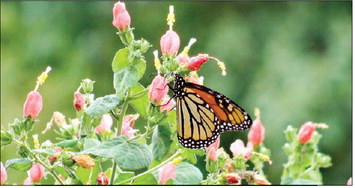
Monarchs depend on milkweed plants for the egg and larval stages. Weighing less than 1 gram, they can live up to nine months. Courtesy photo

